Buying as a moral choice
A thought that I've frequently struggled with lately is that it seems so easy to move away from the problems of the current moment, if we just collectively (and therefore individually) refuse to participate. But the collective part rarely, if ever, happens. And I struggle to understand why.
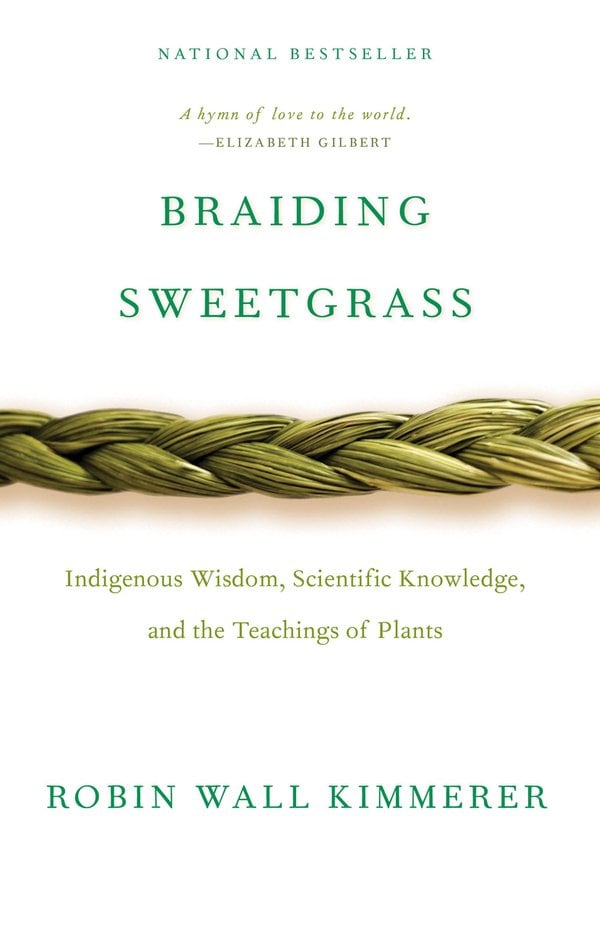
I recently began reading Braiding Sweetgrass. I'm not even through the first section, "Planting Sweetgrass" and I have wanted to think through my immediate reactions to several statements or excerpts. I very well may continue with more as I read further into the book, but I'll start first with a statement from the chapter "The Gift of Strawberries."
In this chapter, Robin Wall Kimmerer writes of how the idea of commerce can cheapen so much of our existence, that by severing the connection between obtaining our food directly from nature or preparing it ourselves, we lose the appreciation for the gift that we've been given. She writes:
How, in our modern world, can we find our way to understand the earth as a gift again, to make our relations with the world sacred again? I know we cannot all become hunter-gatherers–the living world could not bear our weight–but even in a market economy, can we behave 'as if' the living world were a gift? (page 30)
She suggests that we follow the lead of Wally, a man who refused to pay for sweetgrass (just described in an anecdote), because sweetgrass belongs to no one - it can neither be bought nor sold. His position when faced with such an opportunity, and the author's interpretation and extension of that philosophy were therefore:
'Don't buy it.' Refusal to participate is a moral choice. Water is a gift for all, not meant to be bought and sold. Don't buy it. When food has been wrenched from the earth, depleting the soil and poisoning our relatives in the name of higher yields, don't buy it. (pgs. 30-31)
This really resonated with me, because a thought that I've frequently struggled with lately is that it seems so easy to move away from the problems of the current moment, if we just collectively (and therefore individually) refuse to participate. But the collective part rarely, if ever, happens. And I struggle to understand why.
I saw Ta-Nehisi Coates speak in the mid-2010s (if memory serves), and one line that he said stuck with me: "Not in my name." I'd heard it before, but his use of it to describe how that is an option for us for all the evil in the world, we can refuse to participate in it, we can refuse to endorse it, and, especially when these evils or wrongful acts are carried out by the government that represents us, we can be clear and loud that we oppose it, we can work to communicate that to elected officials, and we can act in other ways to demonstrate our opposition to it and hopefully end it.
I reached my end point with Amazon probably within 3-4 years of that event. I don't remember exactly why that was the point I did, but I think most likely it was in substantial part due to my skepticism that the company was just too large and too powerful, in addition to the ways that I had learned that it treated its workers so poorly.
The reason I struggle is that so many people seem to understand how companies like Amazon and Google operate, yet people still buy from these companies and use their products. I specifically refer to people who are well informed about history and politics, who properly understand these companies to be opponents to democracy, to labor, to human rights, to competition. People who vote to limit these companies' influence and harm through electoral politics, but then turn around and act as if their financial support is too small to make any difference, so why not use the convenient thing? Why not continue the habits already in place?
I suspected it would be a challenge not to use Amazon, because it had become so easy to do so. It basically had everything, and I had a Prime membership, so everything was available with as little as one click of the mouse, with "free" shipping. And I suspected there would be some things I would not be able to get anywhere but Amazon, at least not without much more time searching and/or substantial effort.
So to make sure I didn't just quickly devolve to buying on Amazon regularly if I couldn't find a few things, I made myself a rule to follow: I would aim to buy in person at a local small business first. If I couldn't find an item that way, I would try other stores that at least had competitors. If I failed to find something after those, I would ask if I really needed it. Only if I reached that point and did, I would allow myself to buy something on Amazon.
I assumed this would happen some times. And that I would struggle to find things and the effort might be too much. But here's the thing - that never really happened. I honestly don't recall spending extra time searching for things I wanted or needed. I don't recall buying anything on Amazon once I stopped. I think at most I made one or two purchases that first year. Within a couple years, I just outright deleted my account. And I have never regretted it even a little bit.
So the question I struggle with is: why that isn't more common? Why don't people who understand the threat presented by monopolies and tech giants act in accordance with that as individuals?
A few possible explanations come to mind for why people's behaviors on this don't match their broader politics:
- People don't think of buying as a moral choice. The more specific reason may be that people ascribe to the idea that "there's no ethical consumption under capitalism."
- People think it's too easy, or it's too much of a sacrifice not to spend their money and efforts with these companies.
As to the first, writing this has crystallized my reaction to the idea that there's no ethical consumption under capitalism. I've long disliked that framing. To articulate it, I don't care for that idea because it flattens a broader and more complicated critique into a simple platitude that removes any responsibility for people to consider ethics when they spend money. And while it may be impossible to engage in commerce with perfect ethics in a capitalist system, I do not think that absolves us of the need to at least try to make ethical decisions when we do so. [I know I should give this topic quite a bit more thought, so if you have any suggestions, I can add them to my impossibly long and always growing "to read" or "to watch" lists.]
As to the second, is the perceived sacrifice the reason for continued support of these companies, even for people who hate big money in politics, for people who hate oligarchy and corruption, at least among those people who understand that Amazon is (and companies like it are) a primary contributor to these problems?
Or do they consider large-scale problems created or enacted by these companies effectively severed from individual transactions?
Because if they think the convenience is worth the problems, that implies an actual consideration of the trade-offs, and a conclusion that the convenience is worth it. In other words, the individual sacrifice to shop elsewhere is too great to avoid those institutional harms. It is a greater harm to individuals to shop with other sellers, or to pay a bit more for an item, or to wait longer to receive an item, greater than the overall costs of all the negatives that lead to that convenience and that (only possibly) lower cost - of the employees working in terrible and unsafe conditions, of Amazon's efforts to block union organizing, of the company setting up an enormous surveillance system across the country (and beyond, I'm sure), of rivals either not selling goods anymore (and at cheaper prices) or going out of business because they were temporarily undercut by Amazon until they were no longer a competitor.
If that's the conclusion you've come to, intentionally or not, I only ask that you try the sacrifice (for the first time or again). Even if that attempt is limited to a small subset of your purchasing. I think you're likely to find that the sacrifice is not so great as you feared. And even if not, it may still be a sacrifice you find yourself more willing to make.
As a quick but related tangent: I understand why this book has made the rounds of book clubs, podcasts, readers' recommendations. It is fundamentally excellent. One way I've reduced my usage of Amazon is to link to other sites when sharing an item. I'd definitely recommend checking your local library for it. Otherwise you can buy Braiding Sweetgrass on Bookshop to support small and independent bookstores:
 Robin Wall Kimmerer